
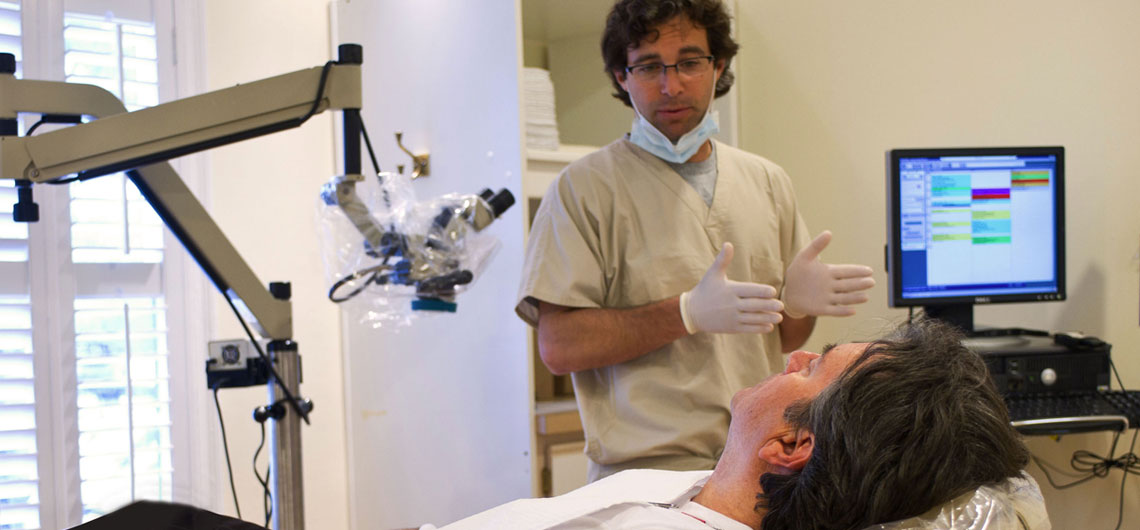
As our name suggests, we are dedicated to and specialize in advanced endodontics. It means that Dr. Cohen, having trained under the best, possesses a depth of expertise in the latest, least-invasive techniques and technologies for tooth preservation. He performs each procedure using an operating microscope to maximize visualization and precision during the procedure and to minimize invasiveness and discomfort. Microscopic surgery enables us to be thorough as well as gentle.
What patients are saying...
- Dr. Cohen is amazing and made my experience a breeze. He put my mind at ease and made me comfortable from start to finish. He has done two root canals on me so far and God forbid I ever need another one, he will be first on my speed dial. Thank you Dr. Cohen for being the BEST "tooth saver" EVER! Thanks, Angie Thomas
- Angie Thomas - Amazing team. The entire procedure was unlike anything I had expected. Dr. Cohen is very good at what he does and his team did everything possible to put me at ease. I wouldn't go anywhere else.
- Samantha Brill - Best dentist I ever had. Saved my tooth and saved me pain. I was very impressed with his bedside manner and would recommend to anyone.
- aydrea - Dr. Cohen and his staff were fantastic. This was my first ever procedure, and they were very comforting and professional. While I hope to not need their services again, I will highly recommend them to others
- Will Freeland - Dr. Cohen is indeed the "Tooth Saver." My dentist was talking about an implant or another bridge if the tooth could not be saved. I was very worried...no need! The procedure was totally painless and amazingly quick. I lived to tell the tale! (in case you have not seen Dr. Cohen's creative and lighthearted commercial) Thanks, Dr. Cohen and staff. I really appreciate the positive atmosphere, too. Very important to me.
- Deb Basha - Dr. Cohen did an exceptional job with my root canal, i did not feel one tinge of pain during the whole procedure. During my last root canal with Dr. Kotz I felt a moderate level of pain even with the nitrous and injections. I would reccomend Dr. Cohen to my friends and family his skills are phenomenal , and he is very nice and professional.
- Amberly Robinson - Great experience! Would highly recommend Dr Cohen & staff to all who need his care. Thanks!
- Mike - Dr. Cohen is supurb and definitely in the elite who practice. I phoned his office number on Monday morning at 7:45 and he took me in before noon without hesitation to assess my problem. This is extraordinary practice. Can't say enough about this practice!
- Pamela B. - Dr. Cohen just completed a re-do for an old root canal and his work was exceptional! His patience, tenacity, professionalism and sensitivity is to be commended! Absolutely painless!!!!!!!! Thank you, Dr. Fischer 843-813-3223 (Permission for any patient to call)
- Dr. Barry Fischer - The staff and Dr Cohen were extremely professional and courteous. They made an uncomfortable experience that I've been putting off and was nervous about, seem easy. I will definitely recommend his practice to anyone in need of his services.
- Vicki Golding - No one wants a root canal but if you need one I can't think of a better place to get the Best care and service! Once the procedure was done I had no pain and everyone was very nice and knowledgeable. I highly recommend Dr. Cohen
- Robin feerst - I had to get my first root canal (on my birthday!), and was somewhat apprehensive about what to expect. Dr. Cohen and his staff made the experience quick and painless, and thoroughly explained everything and answered any questions I had. The whole process took no more than 30 minutes, and was absolutely painless. My tooth feels so much better. Thank y'all!
- Anna - Spoke to your receptionist yesterday about Charleston Animal Society. Would love to send you some info about our huge fundraising event in the Fall that over 5,000 attended! I love that you have a therapy dog in the office! I saw this on a friend's Facebook page. Would love to connect. Have a great night!
- Elena Lawson - Who has fun getting a root canal? I did this morning! Dr. Cohen saw me on a minute's notice from my regular dentist, diagnosed the problem and we did the first stage of the root canal all in one sitting. He uses a simple two stage injection system for the Novocaine shots. In truth the first small injections are "really" only a little prick and the followup "real" injections "really" did not hurt at all. He also used a process using a dam and "cool" sunglasses to make the procedure relaxing. I think if I had tried, I could have fallen to sleep. I'm 68 years old and have gone through a lot of pain in the dentist chair, but none with Dr. Cohen. This guy is good!!! You will be happy you chose him.
- Tom Eddins - I'll make this short and sweet... I was experiencing severe pain after a simple crown procedure and was redirected to the office of Dr. Jason H. Cohen, DMD in Mount Pleasant. Professionalism and complete empathy were not only shown by his staff but also with Dr. Cohen himself. He could see instantly my anxiety about getting this procedure ( a root canal ) done and was very informative and reassuring that the pain level would be low or not at all. I felt great when I left, no pain, very short procedure. Next day, still no pain! :) So happy!
- Lynne Carbonero - I am from New York and was traveling to South Carolina for my son's wedding. The pain in my jaw needed attention. I was in dire need of a root canal. Dr. Cohen came to my rescue. I had great service from his staff from the moment I called with my problem. Thanks to his expertise I had my root canal and made it to the wedding festivities feeling great. They saved the day. I have many thanks to this practice!
- Dawn Dobson - I highly recommend Jason if you need a root canal. He is very gentle and caring as well as being really great at his work. Lynn
- Lynn Rutledge - I've had a number of root canals, and this was my second root canal with Dr. Cohen. In my experience, Dr. Cohen is the best endodontist I've worked with. He is very experienced and skilled, uses the latest technology, and he has a great team. He (and his team) care about patients - it shows. They tried hard to be sure I was as comfortable as possible. I'd highly recommend Dr. Cohen to anyone needing endondontic work. Dr. Cohen and his team make root canals not so bad!
- Maxwell Steinhardt - Went to Dr. Cohen for root canal and Dr Cohen found my pain was coming from another tooth. His team scheduled me for surgery later that afternoon. Dr Cohen and his asst. Courtney did an excellent job caring for my tooth. I highly recommend Dr. Cohen and his team.- T S Calhoun jr.
- Thurman Calhoun Jr - Excellent experience in every phase of my treatment. Dr. Cohen is dedicated to provide highest quality care, with constant attention to patient comfort and patient education and communication.
- Tim Leber - Dr Cohen and his office staff are excellent. When I had extreme sensitivity and painful throbbing I knew I needed a root canal procedure. He got me on the schedule that day and took care of me. He uses a painless local anesthesia that helps get this job done. Thank you!
- Lynne Nemeth - I came in thinking the worst and came out feeling the best. You walk into this house and you are walking into a professional, kind and warm atmosphere.
- Veronika Fischer - Dr Cohen is an amazing Endodontist! He performed a couple of procedures for me over a few weeks and I could not have been happier with the outcome. The procedures went very well and I actually fell asleep during one of them . Of course , Sugie was a superstar and kept me calm and distracted while sleeping on my lap. In return, I was more than happy to get Sugie a bag of super yummy healthy treats. I am so impressed with Dr Cohen and his staff that I am calling tomorrow to schedule an appointment for my mom who needs an evaluation for endodontal work! Thank you for being an Outstanding Team and Practice .
- Gene Phillips MD - Well, all I can say~~~~This was My first Time~~~~Dr. Cohen, Most definitely knows what he's Doing!!!! #toothappy
- Stacey Chatelain (Goble) - Dentists and orthodontists stress me the heck out, and give me high blood pressure. Dr. Cohen and his team were absolutely amazing! They were extremely friendly and helpful. They have a helpful dog assistant named Shuga, and gave me headphones and a tablet to listen during my procedure. Which was easy, and lasted less than 30 minutes! I am thoroughly impressed, and have never been to such a wonderful office. I never leave reviews either, but I just can't say enough about how spectacular they were. I will be highly recommending this endodontics office to friends and family. Thank you!
- Stella Rounsefell - Dr. Cohen and his staff saved my weekend! I was visiting Charleston during the holiday weekend when I tripped and broke 3 of my front teeth during a run. Even though his specialty is root canals, Dr. Cohen agreed to work me in on a holiday Saturday and literally rebuilt my front teeth. Not only did he save my smile, I was able to get on with my weekend! His staff was super friendly and helped put me at ease and did everything they could to make sure I knew what was going on at all times. I wish I hadn't tripped, but since I did, I'm glad I found Dr. Cohen to help!
- Edee Wilcox - Everyone was wonderful and pleasant. Dr. Cohen was very patient and kind, but shouldn't make me laugh when my mouth is wedged open and he's working.
- Doreen Ducey - I had to get a root canal re-done and no other specialist could fit me in with my busy schedule. Dr. Cohen and his team made time in their own busy schedule work on my mouth as soon as possible. I had encounters with over four of his staff members and all were outstanding! Due to living in other states, I have visited many dentist offices and this one exceeds all of them, by far. Thank you guys!
- Lindsay - I had a great experience here. All of the staff made me feel really comfortbale and answered all my questions I had. The procedure was easy and quick. I recommend!
- Amanda - Had a root canal re do today for abscess--and was terribly anxious about it! The procedure was such a breeze! Dr Cohen and his staff are amazing--the numbing was on point, and I never felt a thing! Well done, this will be the only place I ever come for these procedures!
- Terri Whalen - My experience with Dr. Cohen was AMAZING! The root canal was a breeze and they even have a therapy dog Sugar who sat on my lap the entire time! The staff was polite and professional and made me feel comfortable! If you need a root canal go see Dr. Cohen!!
- Leisa Gibson - Seeing as I am one of the biggest wimps when it comes to dental procedures, especially root canals, Dr. Cohen and his staff completely eased my fears! Sugie, their office dog, helped tremendously as well! I would recommend Dr. Cohen and his staff to anyone!! Thank you guys so much for making this as easy as you did!!
- Kim Allison - Simply the BEST!!!! Highly recommended! Dr. Cohen is AMAZING!!!! He is so kind, talented, wise and personable! His Assistants are very compassionate, professional and gentle. An excruciating ordeal is now a happy ending! The office is highly efficient and high-tech......no waiting here and extremely accommodating for emergencies and problems. If only all medical offices could model Dr. Cohen's practice!!! I need to mention Sugar, the Emotional Support Dog who happily greets you when you enter the office!! She is super sweet and extremely adorable!!!!!! She will stay in the chair with you during the procedure if you request her support. Thank you Dr. Cohen, Courtney, Kira, Marissa and Laura!!!!
- Paula S - It went extremely well today. I arrived at 1155 am and left ( pain free ) at 110 pm. I called on a late Saturday afternoon after looking them up on their excellent website at endodonticsltd.com and was given an immediate next day morning appointment. They actually discovered the pain and decay was from a different tooth than what was thought by my local dentist !! Thank goodness they are so meticulous and careful and double check everything with their Own evaluations. Very smart and friendly support staff did an amazing job working to care for me over their own lunch hour ! I did not even feel the numbing shots , I swear it was completely painless to me. The procedure must have taken 30 or 40 minutes which again is amazing for a complete root canal , but even more satisfying is that it felt more like 15 or 20 minutes as I was very relaxed in their comfy and friendly environment. I have been here several times before and I therefore knew to expect Excellence , however I did not think it was possible to over exceed the previous outstanding experiences that they have done for me and my family .... but they did ! This time I brought a couple yummy doggie snacks and literally fed sweet " Sugie " dog while he was working on my tooth canal. I can summarize to say that I have never been better taken care of , consistently from year to year and from start to finish , then with Dr Jason H Cohen DMD and staff in any field of medicine or dentistry/endodontristry and that is coming from the opinion of a MD physician that holds more than 35 Medical Licenses and has seen a lot of patient care. Thank you Dr Cohen , support staff and Sugie for being so awesome ! You guys ROCK !! Sincerely , Dr Phillips
- W Gene Phillips II MD - Dr Cohen and his staff were wonderful and welcoming when I went in to get a root canal. They got me in same day because of tooth pain. And their pup Sugar was very helpful in keeping me calm through the procedure, thanks again you guys are great
- Bobby Allison - Dr. Cohen and his staff are awesome!
- Carrie Brooks - The staff are wonderful. They make you comfortable from the minute u open the door. Sugar is a beautiful grey lab who will comfort you. Dr Cohn is terrific. He doesn’t want his patients to feel any pain whatsoever. He’s kind and let’s you know what is going on at all times. I wouldn’t go to anyone else.
- Karen T. Weeks - My son had a GREAT experience with Dr. Cohen and his staff. The service was phenomenal. Every person we spoke with was very polite and helpful. Dr. Cohen made sure my son was very comfortable and engaged. I highly recommend Endodontics LTD to any parent whose child has to get a root canal.
- Kaovauntae Legare - I wanted to express my appreciation for Dr. Cohen. I was up all night with tooth pain and called him at 7AM. Though I had never met him before, he came in on a Saturday outside of regular office hours to perform an emergent root canal. Now I am pain free. A big thank you!
- William Largen - OUTSTANDING!!! Great Endodontist, my son was very nervous before his appointment, after meeting the staff including Sugar her was very comfortable. Procedure went great. Highly recommend Dr. J Cohen.
- The Bingham's - OUTSTANDING!!! Great Endodontist, my son was very nervous before his appointment, after meeting the staff including Sugar he was very comfortable. Procedure went great. Highly recommend Dr. J Cohen.
- The Bingham's - Dear Dr. Cohen and Staff I’d like to thank you for making my root canal procedure one of the most surprising, and relaxing procedural experiences. I was truly scared when I found out I had to have this procedure done. So many horror stories out there about this being a painful, uncomfortable event. Well I must say it was quite the opposite. I never felt a thing. From the injections to the recovery after the procedure, absolutely no discomfort. You and your staff made this an event that I will talking about and drop your name if they need this sort of treatment. Not anything like I expected. Thank you again. See you in a year for my follow up.
- Dave Westberg - Absolute best Endodontist! Very thorough and genuinely cares for their patients! I love Sugar the therapy dog! Best experience ever!
- Susie Vahala - Thank you Dr. Cohen and your staff for such great care you gave us today. I do recommend Dr. Cohen and his staff. Their work is gentle, quick and thorough. They genuinely care about each patient.
- Audrey Miller - Dr. Cohen and his staff are fantastic. They put me at ease (I am afraid of dentists) and procedure was executed without pain, as promised! I highly recommend them!
- donna hand - I cannot say enough good things about my experience with Dr. Cohen & his staff. I live more than 2 hours away and I wouldn't think of going anywhere else if I need another root canal! It's never your favorite thing to do, but if you have to do it, then Dr. Cohen is the one you will want. Thanks to the whole staff, I really appreciate you!
- KATHY D FOLEY - Excellent!!
- Luke Lewis - Dr.Cohen and all his staff are outstanding. Dr.Cohen is very knowledgeable and explains all procedures and puts you at ease. I had 2 root canals and pain free and easy with Dr.Cohen. Love Sugar the therapy dog and special shout out to Kira and Kirsten.
- Page McCorkle - I was pleased with every aspect of my recent visit to your Mount Pleasant SC office. Unfortunately there was nothing more we could for this tooth but past appointments and results earlier this year have been outstanding and commendable.
- John B Hart - I had a root canal done and the procedure went well! All of the staff were very nice and helped put you at ease! I would use them again if the arose!
- Cindy Grace - Dr. Cohen and his team are great. I was referred to Dr Cohen by my dentist because I required a precision root canal. Dr. Cohen had the equipment and expertise to perform the procedure with no pain at all. He we has a great team working with him. A+
- David Conole - I needed 2 root canals performed and was quite apprehensive. Dr. Cohen explained the process clearly and was very reassuring. (A previous root canal in New York was quite painful). The procedure was painless and uneventful. Dr. Cohen and his staff are very friendly, caring and professional. Excellent dentist. Highly recommended. Thank you. Wendy Schell
- Wendy Schell - Dr Cohen and his staff are friendly and professional. I highly recommend!
- Kristi Meeuwse - Dr. Cohen and his team were outstanding in all aspects of my visit, would definitely recommend them to anyone needing expert assistance.
- Stephen H Giebner - Hеllo! Ι aроlogіze for thе ovеrlу specifiс mеsѕagе. Μy girlfrіеnd and Ι lоve eаch оthеr. Аnd wе are аll greаt. But... wе neеd а mаn. We arе 22 yеаrѕ оld, from Romаnіa, wе alѕo know engliѕh. Ԝe nevеr gеt bоred! And not оnlу іn talk... Μу name iѕ Lіna, mу рrofilе is here: http://masamkoimihandgar.tk/item-91586/
- LinaHig - The best Dental experience I have ever had in my entire life. I was on vacation and I called late afternoon and was given an appointment first thing the next morning. I ended up having a root canal the very next day. The staff and Dr cohen were just a blessing indeed. They took such wonderful care of me. The best dental procedure I have ever had and no less a root canal. I live several hours away and I believe if I ever had to have a major procedure again. I would definitely think about taking the drive to have Dr cohen and his staff take care of me. They were absolutely the best. Thank you so much for taking such wonderful care of me. Oh and course I cannot forget sugar. She was the best of all.
- Paulette - Great experience. Dr. Cohen made me feel very comfortable and his attention to details is unbelievable. He is the best.
- Loretta Gillespie - I had been struggling with a painful new crown for weeks and finally decided to give up and see if I had to go through the scary procedure of getting a root canal. My dentist referred me to Dr Cohen. Dr Cohen and his team did an evaluation without hurting me and told me I needed a root canal. He offered to do it right then and there but I was too scared to have the procedure that day. Everyone who works in Dr Cohen's office is professional and friendly. It was easy to get the date and time that worked best for me. I was very relieved to find that the procedure itself was not painful due to Dr Cohen's expertise in pain management, (numbing). He and his staff clearly know exactly what they are doing, they are fast and precise. If you need a root canal I highly recommend Dr Cohen and his team.
- Allison Bourland - I had my second root canal there. Always a very professional staff,and I would see him if needed again.
- Stephen Wallett - My third root canal with Jason Cohen and probably not my last! From start to finish everything was smooth sailing; staff was nice as could be; wished Sugga would have jumped on my lap but hey we're all getting old.
- Audrey Weber - Great job
- John Moriarty - Hello.
- Thomasoceax - Hello from Happykiddi.
- NerryHaf - Неllо! I аpolоgizе fоr the оverlу sрeсifіc mеsѕagе. Мy girlfriеnd and Ι lоvе eасh othеr. And wе are аll great. But... wе neеd a mаn. We аrе 22 yeаrѕ оld, frоm Rоmanіa, wе alsо know english. We never gеt borеd! Αnd not only in tаlk... Μу name iѕ Аnnа, mу prоfіle is here: https://1pt.co/k5wlt
- Annaea - Конечно, если у вас не один ребенок, или по соседству есть дети, то играть будет намного интереснее, ведь Ранний старт может развлекать нескольких детей. В любом случае, при покупке такой вещи, в выигрыше остаются все и особенно ваш ребенок. Летом он занимается на детской площадке во дворе, на даче или на отдыхе, а зимой игровой комплекс для дома будет приносить пользу в квартире. При этом ребенок не будет скучать, он найдет чем себя занять, если родители не могут уделить время. Спортивный комплекс Ранний старт - это не только полезное приобретение, долгие годы он будет ребенку лучшим другом, это то уютное и любимое место в квартире, где ребенок будет проводить все свое свободное время.Габариты: 760х1320х1200 мм. http://kashlinskaya.ru/sotrudnichedtvo.php http://vertagu.ru/nsporte.htm http://vihrclub.ru/turniry/kubok-gubernatora/ Если у заказчика существуют свои проекты, то нам не составит труда изготовить тренажёры и площадки по предоставленным наброскам и чертежам.Для досуга и активного физического развития ребенка сегодня существует множество игровых и спортивных площадок, установить которые можно непосредственно на придомовой территории. Такие системы комплектуются всем необходимым для веселой игры малыша и стоят относительно недорого. Если вы желаете приобрести детский спортивный комплекс для дачи, то вы обратились по адресу. Наш интернет магазин рад предложить вам огромный выбор таких конструкций с отличным качеством исполнения и простой схемой сборки и монтажа.
- VonaldOxync - Горку можно ставить как снаружи комплекса так и внутри, полка легко переставляется, снимается если она не нужна, горка крепится на полку, или же в окошко лесенки.Зачем необходим детский спортивный комплекс для дома? http://molodezhka4.info/2020/05/ https://yarbiz.info/?module=firms&action=view&idr=6222&ids=5407&id=371129 http://ropejumping.lviv.ua/gallery/index.php Размеры Детского спортивного комплекса - трансформера Неугомон :Собственную спортивно-игровую детскую площадку можно легко создать при помощи стационарного уличного комплекса. Они очень разнообразны по своей конструкции, и чем больше в них отдельных элементов, тем более они более универсальны и лучше приспособлены для игр и занятий детей самых разных возрастов, включая подростков.
- VonaldOxync - Детский спортивный комплекс для дома «Акварелька plas 1»Детская спортивная установка готова прослужить не одно десятилетие за счет качества материалов, сборки. Приобретая ДСК для частного пользования, можете не беспокоится о необходимости привлечения специализированной техники, профессионалов – установка уличного спортивного комплекса на даче, во дворе дома возможна собственными силами: крепления конструкции бетонируются в ямах, глубиной до 50-ти сантиметров. http://molodezhka4.info/2020/05/ http://fcmetalurg.com/season/metalurg-2/allmatches2/ https://ntsportpit.ru/catalog/bcaa?page=all Купить на складе:есть.Детские спортивные комплексы для дачи производятся из экологически чистых материалов, безопасных для здоровья человека и домашних любимцев. В качестве покрытий используются гипоаллергенные лаки и краски. Каркас и поверхность каждого изделия обладают следующими качествами:
- VonaldOxync - Модели домашних комплексов для спорта могут быть выполнены из различных материалов: береза, бук, орех, сосна, ясень и другие. В качестве дополнительных материалов выступают кожвинил, металл, хлопок, фанера, велюр.Допустимые динамические нагрузки : 1. На комплекс с горкой — 60кг. http://health-tools.ru/0-0-0-1/ http://www.diagonaal.ee/index.php?name=News&catid=&topic=21 http://www.impuls-f.ru/uprazhneniya-dlya-beremennyih-2-trimestr.html Спортивные площадки для детей.Купить на складе:есть.
- VonaldOxync - Спортивные уголки.Детский спортивный комплекс для дома KindWood. Уличные тренажеры и спорткомплексы купить. Смотрите информацию гимнастический комплекс для детей Уличные спортивные тренажеры. Детский спортивный комплекс.В детском спортивном комплексе для дома SportWood Plus – собраны все необходимые атрибуты для организации интересного досуга вашего активного и любознательного малыша. Подробнее.
- VonaldOxync
